Corcovado Part 2
In this next section we will look at the next 8 bars. The next four bars utilise bar chords Gm7 and C9 barring the 3rd fret and chords F#m7 and B7#5 barring on the second fret.



In this next section we will look at the next 8 bars. The next four bars utilise bar chords Gm7 and C9 barring the 3rd fret and chords F#m7 and B7#5 barring on the second fret.

Corcovado, also know as Quiet Nights of Quiet Stars is a popular Brasilian Bossa Nova by Antonio Carlos Jobim. In this intermediate guitar arrangement I have changed the key from the original key of C and moved up one tone to D major to make use of more open strings. The feel is not […]

When it comes to guitar techniques on the guitar nothing beats the magic of the guitar tremolo. There are many guitar tremolo pieces in both the classical and flamenco styles but the most iconic tremolo piece is Recuerdos De La Alhambra by Francisco Tarrega. In this video I will show you how to practice and […]

I caught up with Milos recently to chat about his career and recordings. This interview is an excerpt of my longer form conversation with him about his recording of Concerto Aranjuez. The full interview is available here in the Interviews Section here.

Consider joining my email list and receive special offers. In the meantime here’s the PDF download:

Today I want to share with you my arrangement of the popular Spanish/Flamenco piece Rumba Flamenca. The Rumba is a common flamenco dance form (Palo) characterised by the rhythm 3 – 3 – 2. A Rumba is traditionally played at a slow to medium pace but this arrangement is more dramatic at faster tempi. I […]

I’ve had a few comments about improvising over flamenco chords and in particular over the Spanish Cadence. The Spanish Cadence is a very common chord progression that occurs in Spanish music and flamenco which uses the chords IV – III – II – I. It is usually in a minor key and often occurs […]

Sheet Music Download / Play-Along Track / Lesson Notes or
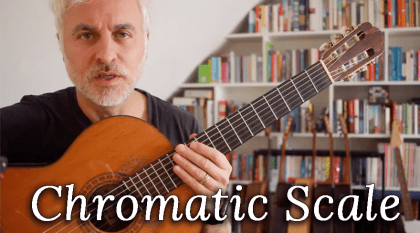
In this video we will be exploring what the chromatic scale is and how to practice it on the guitar. The chromatic scale is a 12 note scale that includes all the notes within the octave. This will include natural notes and accidentals. So for example, we can play the E chromatic scale starting […]

The Milonga is an Argentinian musical genre. It is similar to Tango but is generally played quite slowly and generally in 2/4 time. It originated in the Rio de la Plata areas of Argentina, Uruaguay, and Brasil. Milonga has a syncopated beat, consisting of 8 beats with accents on the 1st (sometimes also 2nd), 4th, 5th, […]